This is default featured slide 1 title

Go to Blogger edit html and find these sentences.Now replace these sentences with your own descriptions..

This is default featured slide 2 title

Go to Blogger edit html and find these sentences.Now replace these sentences with your own descriptions..

This is default featured slide 3 title

Go to Blogger edit html and find these sentences.Now replace these sentences with your own descriptions..

This is default featured slide 4 title

Go to Blogger edit html and find these sentences.Now replace these sentences with your own descriptions..

This is default featured slide 5 title

Go to Blogger edit html and find these sentences.Now replace these sentences with your own descriptions..

Tuesday, June 21, 2011

Motorola Droid 3 Pops up in GLBenchmark-A VerizonXT883 with OMAP4

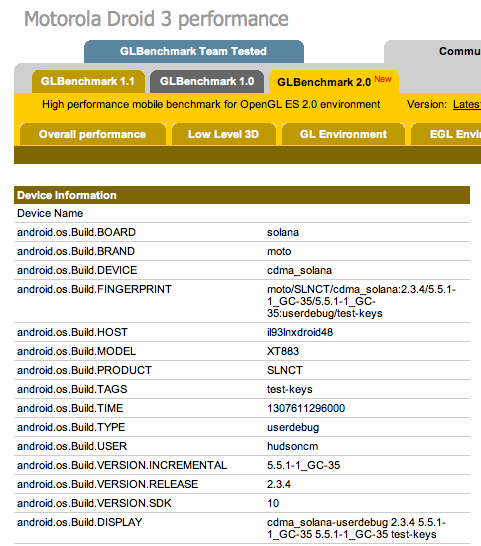
A tipster dropped a link our way early this morning to a GLBenchmark 2.0 results browser page that might be of interest to many. Hit that page and you'll find a complete run of the current GLBenchmark 2.0 suite, and a bit of a confirmation about what is and isn't the upcoming Motorola Droid 3. It isn't Tegra 2, it's OMAP 4430.

First off, the hardware specifications that we can glean from the information page seem to make it a virtually identical match with the specs of the Motorola Milestone 3, or XT883. That means a qHD 960x540 display likely 4" in size, hardware five-row QWERTY keyboard, Android 2.3.4, a possible 1 GB of LPDDR2 (512 MB is the other less-desirable, rumored number), 8 MP rear camera, front camera, and of course an accompanying CDMA2000 baseband for Verizon.


Given the number of recent flagship Motorola product launches with Tegra 2 SoCs, starting with the Motorola Atrix, the Droid X2, and the now-delayed Droid Bionic it seemed that a flagship (read: QWERTY keyboard-packing) summer Motorola Droid launch with Tegra 2 was inevitable. From the results page, it now seems that the Motorola Droid 3 will include a 1GHz OMAP 4430 SoC with PowerVR SGX 540 graphics, and not a Tegra 2.

The model in the results browser is codenamed "Solana" which matches the codename we've heard about for the Verizon-bound Motorola Droid 3. The photos below are of the XT883 which the Motorola Droid 3 will undoubtedly bear an uncanny resemblance to.


Motorola Milestone 3 - XT883 for China (courtesy: Motorola Mobility)

The benchmarks themselves paint an interesting picture, and while we're at it I've tossed in some other devices we have in-hand but haven't finished our full reviews of yet for comparison with these results from the Motorola Droid 3. Again GLBenchmark 2.0 runs we're reporting here are at native resolution for the respective devices, which we've now included in the description line for comparison. For a quick refresher, WVGA is 800x480, FWVGA is 854x480, and qHD is 960x540. 

GLBenchmark 2.0 - Egypt
GLBenchmark 2.0 - PRO

I've highlighted the previous Motorola Droid 2 results (which we reviewed last year) just for fun to illustrate how far we've come in one calendar year.

Nokia N9 &N950 Officially Announced -MeeGo Running on OMAP3630

Back when we reviewed the Nokia N900 we really only wanted a few major improvements. A faster SoC, slightly thinner and more compact hardware, and more of Maemo Linux. It's been a long wait since then, and Nokia has changed its lineup, canceled the original N900 successor, taken on a new CEO, and rebooted itself under the Windows Phone 7 umbrella.

Those of us that wanted a smartphone running real bona-fide linux seemed destined to be waiting forever. Today however, Nokia officially announced the Nokia N9 and N950 at its Nokia Connection event in Singapore.

The N9 runs MeeGo, which as you likely know by now is the combination of Nokia's Maemo and Intel Moblin. MeeGo in smartphone form has something we've been waiting patiently for. The N9's industrial design looks nothing short of stunning, though all of the photos of the device so far appear to be renders and not actually physical hardware.

What's unique about the N9 is that the front of the device is buttonless, virtually everything is accomplished by tapping on the capacitive touchscreen, including unlocking the device. There's still volume, power, and camera buttons however. 

Nokia really seems to have spent a lot of time working on UI for MeeGo as evidenced by an interesting three home screen design, emphasis on using the swipe gesture to change applications, and pinch gestures for getting a multi-window view. The three home screens are purpose-designed for launching applications, viewing open applications and multitasking, and managing events such as news and messages. 

The N9 is polycarbonate plastic and unibody construction, and is sans-keyboard. Its cousin is the similarly-specced N950, which is a non-retail developer device that looks like what remains of the original N9. There are anumber of small differences between the N9 and the N950, chief among which is inclusion of a hardware QWERTY keyboard and aluminum construction, thanks again to Simon for finding these differences and tipping me on them. 

Nokia Device Specifications
  Nokia N9 Nokia N950
Height 116.45 mm (4.58") (?)
Width 61.2 mm (2.41") (?)
Depth 7.6 - 12.1 mm (0.3" - 0.48") (?)
Weight 135 g (4.76 oz) (?)
CPU TI OMAP 3630 @ 1 GHz TI OMAP 3630 @ 1 GHz
GPU PowerVR SGX 530 PowerVR SGX 530
RAM 1 GB LPDDR 1 GB LPDDR
NAND 16GB or 64GB integrated 16GB or 64GB integrated
Camera 8MP Carl Zeiss 16:9 F/2.2 with Dual LED flash and 720P video capture, Front Facing (?MP) 8MP with Dual LED flash and 720P video capture, Front Facing (?MP)
Screen 3.9" FWVGA (854x480) AMOLED with Gorilla Glass 4.0" FWVGA (854x480) LCD-TFT
Battery 1450 mAh Integrated(?) 1320 mAh
Bluetooth Bluetooth 4.0 Bluetooth 2.1+EDR
WiFi 802.11a/b/g/n 802.11a/b/g/n
NFC Yes No
Sensors Accelerometer, Compass, Proximity, Ambient Light "N9 has a slightly more sensitive magnetometer and ALS"
OS MeeGo 1.2 Hartmattan MeeGo 1.2 Hartmattan

The two devices also have pentaband WCDMA support and quad band GSM/EDGE support, though there's no word on what cellular baseband is at the core of everything. In addition, the N9 includes NFC support, though Nokia hasn't specifically stated whether all three NFC modes are supported. In all likelihood this is assumed now given NFC chipset maturity.

Though the SoC seems dated for a device that still isn't released yet, it's a definite improvement over the N900's 600 MHz OMAP 3430.

Nokia N9/N950- Network Support
GSM/EDGE Support 850 / 900 / 1800 / 1900 MHz
UMTS/HSDPA/HSUPA Support 850 / 900 / 1700 / 1900 / 2100 MHz
HSDPA/HSUPA Speeds HSDPA 14.4 / 5.7 Mbps
Baseband Hardware (?)

The device looks solid, though there's no word on a specific release date or pricing, just "later this year." Nokia has provided a quick specifications PDF, and more information on their conversations blog and website.

Related Posts Plugin for WordPress, Blogger...
Powered by Blogger.