This is default featured slide 1 title

Go to Blogger edit html and find these sentences.Now replace these sentences with your own descriptions..

This is default featured slide 2 title

Go to Blogger edit html and find these sentences.Now replace these sentences with your own descriptions..

This is default featured slide 3 title

Go to Blogger edit html and find these sentences.Now replace these sentences with your own descriptions..

This is default featured slide 4 title

Go to Blogger edit html and find these sentences.Now replace these sentences with your own descriptions..

This is default featured slide 5 title

Go to Blogger edit html and find these sentences.Now replace these sentences with your own descriptions..

Showing posts with label iPhone And iPod. Show all posts

Saturday, July 2, 2011

HTC Sensation 4G Review - A Sensational Smartphone

I like what HTC has been up to lately. Rather than fighting a race to the bottom with endless soulless variants of the same piece of hardware in a crowded (and fiercely competitive) Android handset market, it’s trying to grow beyond just being a handset manufacturer.

I hate starting reviews with history lessons, but in this case we really do need to step back to see where HTC is coming from. In the beginning, HTC was a nameless OEM for other more famous brands. Its clients were smartphone and Pocket PC names like Palm with its Treo, Compaq with its iPaq, Dell with a number of the Axim PDAs, and UTStarcomm. As Windows Mobile aged and showed little signs of improving, HTC took its first step outside the bounds of being just a hardware assembler by taking on an ambitious project to revitalize Windows Mobile with a software skin. The fruits of this effort were TouchFlo, and later TouchFlo 3D UIs - which eventually would become HTC Sense. Somewhere between the release of the HTC Mogul and HTC Touch Pro, HTC realized that its future wasn’t purely in manufacturing devices for other handset vendors, but in leveraging its own brand. The combination of continually improving industrial design, software, and its own direction have turned HTC into the device manufacturer it is today.
Things have come a long, long way since the HTC Dream, and today we’re looking at HTC’s latest and greatest with the HTC Sensation.


I get a bit excited every time I look at the HTC Sensation. It’s a device with perhaps the strongest and most bold design language of any HTC phone to date. You can pretty much chart HTC’s design language by looking at each generation of its international handsets.


The HTC Desire was essentially an international version of the Nexus One, with hardware buttons but the same 65nm single core Snapdragon QSD8250 SoC. The second generation was the HTC Desire HD, which brought a larger 4.3” screen and 45nm Snapdragon MSM8255 SoC. The third step is the HTC Sensation, which ups resolution from WVGA 800x480 to qHD 960x540 and brings a 45nm dual core Snapdragon MSM8260 SoC.

Physical Comparison
Apple iPhone 4 HTC Thunderbolt LG Optimus 2X/G2x HTC Sensation
Height 115.2 mm (4.5") 122 mm (4.8") 123.9 mm (4.87") 126.3 mm (4.97")
Width 58.6 mm (2.31") 67 mm (2.63") 63.2 mm (2.48") 65.5 mm (2.58")
Depth 9.3 mm ( 0.37") 13.2 mm (0.52") 10.9 mm (0.43") 11.6 mm (0.46")
Weight 137 g (4.8 oz) 183.3 g (6.46 oz) 139.0 g (4.90 oz) 148 g (5.22 oz)
CPU Apple A4 @ ~800MHz 1 GHz MSM8655 45nm Snapdragon 1 GHz Dual Core Cortex-A9 Tegra 2 AP20H 1.2 GHz Dual Core Snapdragon MSM8260
GPU PowerVR SGX 535 Adreno 205 ULP GeForce Adreno 220
RAM 512MB LPDDR1 (?) 768 MB LPDDR2 512 MB LPDDR2 768 MB LPDDR2
NAND 16GB or 32GB integrated 4 GB NAND with 32 GB microSD Class 4 preinstalled 8 GB NAND with up to 32 GB microSD 4 GB NAND with 8 GB microSD Class 4 preinstalled
Camera 5MP with LED Flash + Front Facing Camera 8 MP with autofocus and dual LED flash, 720p30 video recording, 1.3 MP front facing 8 MP with AF/LED Flash, 1080p24 video recording, 1.3 MP front facing 8 MP AF/Dual LED flash, VGA front facing
Screen 3.5" 640 x 960 LED backlit LCD 4.3” 800 x 480 LCD-TFT 4.3" 800 x 480 LCD-TFT 4.3" 960 x 540 S-LCD
Battery Integrated 5.254Whr Removable 5.18 Whr Removable 5.6 Whr Removable 5.62 Whr
Physically it’s obvious that each successive device builds on the former. They’re all backed with HTC’s trademark purple-grey metal and have similar in-hand feel as a result. When I look at the Sensation, I see the Desire crossed with the Desire HD. When I actually hold the Sensation, I feel like I’m holding a grown-up Nexus One.


The two share that trademark combination of slightly rubbery plastic and metal, and as a result the device feels grippy, solid, and confident. What the Sensation also really continues from the other devices is the lack of a hard lip of any kind at the edge, instead every corner rolls off giving the phone a smooth feeling. The sensation of holding something rigid and expensive is communicated by that combination of materials, rather than the cheap plasticky feel conveyed by a number of other handsets.


The Sensation comes in the same style of packaging that we've seen other T-Mobile phones arrive in. It's a two-part box with a thin middle strip. The top lifts off revealing the phone, and underneath that is the usual paperwork, HTC AC adapter and microUSB cable, and earbuds.


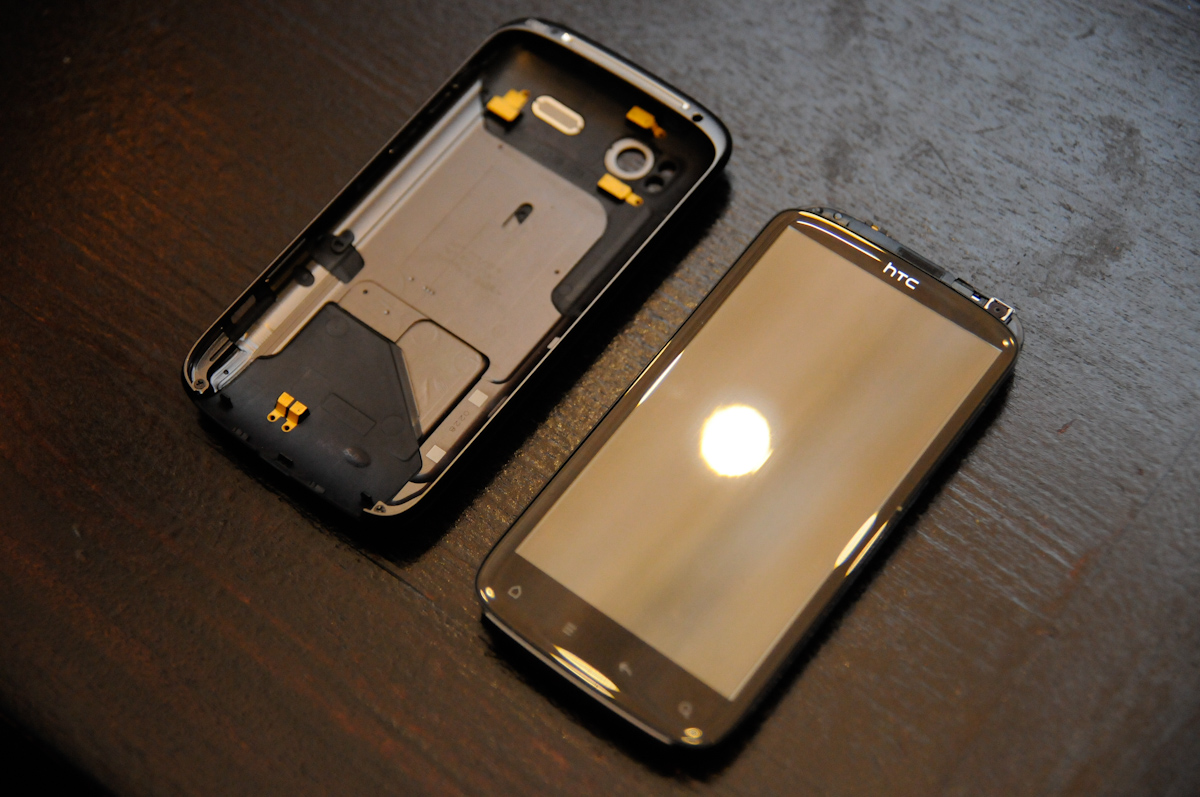
I started off making one monolithic video for the Sensation, but that ended up being unwieldy, so I split it into multiple parts. The first one is simply a look at the hardware from all angles, torn down, and how it compares to both HTC's legacy devices and some of its modern contenders.

Tuesday, June 21, 2011

Nokia N9 &N950 Officially Announced -MeeGo Running on OMAP3630

Back when we reviewed the Nokia N900 we really only wanted a few major improvements. A faster SoC, slightly thinner and more compact hardware, and more of Maemo Linux. It's been a long wait since then, and Nokia has changed its lineup, canceled the original N900 successor, taken on a new CEO, and rebooted itself under the Windows Phone 7 umbrella.

Those of us that wanted a smartphone running real bona-fide linux seemed destined to be waiting forever. Today however, Nokia officially announced the Nokia N9 and N950 at its Nokia Connection event in Singapore.

The N9 runs MeeGo, which as you likely know by now is the combination of Nokia's Maemo and Intel Moblin. MeeGo in smartphone form has something we've been waiting patiently for. The N9's industrial design looks nothing short of stunning, though all of the photos of the device so far appear to be renders and not actually physical hardware.

What's unique about the N9 is that the front of the device is buttonless, virtually everything is accomplished by tapping on the capacitive touchscreen, including unlocking the device. There's still volume, power, and camera buttons however. 

Nokia really seems to have spent a lot of time working on UI for MeeGo as evidenced by an interesting three home screen design, emphasis on using the swipe gesture to change applications, and pinch gestures for getting a multi-window view. The three home screens are purpose-designed for launching applications, viewing open applications and multitasking, and managing events such as news and messages. 

The N9 is polycarbonate plastic and unibody construction, and is sans-keyboard. Its cousin is the similarly-specced N950, which is a non-retail developer device that looks like what remains of the original N9. There are anumber of small differences between the N9 and the N950, chief among which is inclusion of a hardware QWERTY keyboard and aluminum construction, thanks again to Simon for finding these differences and tipping me on them. 

Nokia Device Specifications
  Nokia N9 Nokia N950
Height 116.45 mm (4.58") (?)
Width 61.2 mm (2.41") (?)
Depth 7.6 - 12.1 mm (0.3" - 0.48") (?)
Weight 135 g (4.76 oz) (?)
CPU TI OMAP 3630 @ 1 GHz TI OMAP 3630 @ 1 GHz
GPU PowerVR SGX 530 PowerVR SGX 530
RAM 1 GB LPDDR 1 GB LPDDR
NAND 16GB or 64GB integrated 16GB or 64GB integrated
Camera 8MP Carl Zeiss 16:9 F/2.2 with Dual LED flash and 720P video capture, Front Facing (?MP) 8MP with Dual LED flash and 720P video capture, Front Facing (?MP)
Screen 3.9" FWVGA (854x480) AMOLED with Gorilla Glass 4.0" FWVGA (854x480) LCD-TFT
Battery 1450 mAh Integrated(?) 1320 mAh
Bluetooth Bluetooth 4.0 Bluetooth 2.1+EDR
WiFi 802.11a/b/g/n 802.11a/b/g/n
NFC Yes No
Sensors Accelerometer, Compass, Proximity, Ambient Light "N9 has a slightly more sensitive magnetometer and ALS"
OS MeeGo 1.2 Hartmattan MeeGo 1.2 Hartmattan

The two devices also have pentaband WCDMA support and quad band GSM/EDGE support, though there's no word on what cellular baseband is at the core of everything. In addition, the N9 includes NFC support, though Nokia hasn't specifically stated whether all three NFC modes are supported. In all likelihood this is assumed now given NFC chipset maturity.

Though the SoC seems dated for a device that still isn't released yet, it's a definite improvement over the N900's 600 MHz OMAP 3430.

Nokia N9/N950- Network Support
GSM/EDGE Support 850 / 900 / 1800 / 1900 MHz
UMTS/HSDPA/HSUPA Support 850 / 900 / 1700 / 1900 / 2100 MHz
HSDPA/HSUPA Speeds HSDPA 14.4 / 5.7 Mbps
Baseband Hardware (?)

The device looks solid, though there's no word on a specific release date or pricing, just "later this year." Nokia has provided a quick specifications PDF, and more information on their conversations blog and website.

Friday, June 3, 2011

Hands on Benchmarks MSM8x60 Phones - HTC Sensation 4G and HTC EVO 3D

Yesterday evening I met up with HTC, who let me take a quick look at a number of their upcoming unreleased phones, including the HTC Sensation 4G and HTC EVO 3D. Naturally, the first thing I did was sit down and run a couple of benchmarks during our limited time with the phones, and get an overall feel for the devices. I also spent some time with the HTC ChaCha and HTC Salsa - the two Facebook phones - though my focus was more look and feel for the form factor of the ChaCha given the fact that both are just MSM7x30.

The two phones I played around with the most are both based on Qualcomm's MSM8x60 SoC. For a quick refresher, the MSM8x60 consists of two 1.2 GHz scorpion cores (though MSM8x60 can clock all the way up to 1.5 GHz), and Adreno 220 graphics. As a reminder, the x in MSM8x60 tells us what air interfaces the cellular baseband supports - 2 for GSM/UMTS, 6 for GSM/UMTS + EVDO/CDMA2000. Thus, the MSM8260 is in the Sensation, MSM8660 for the EVO 3D.
 
HTC EVO 3D


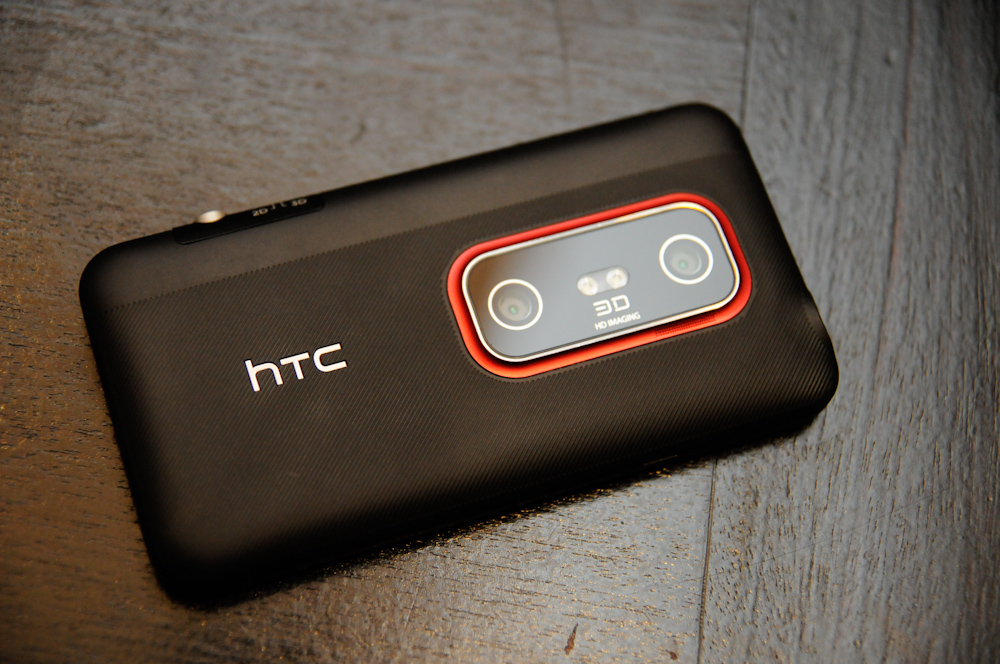
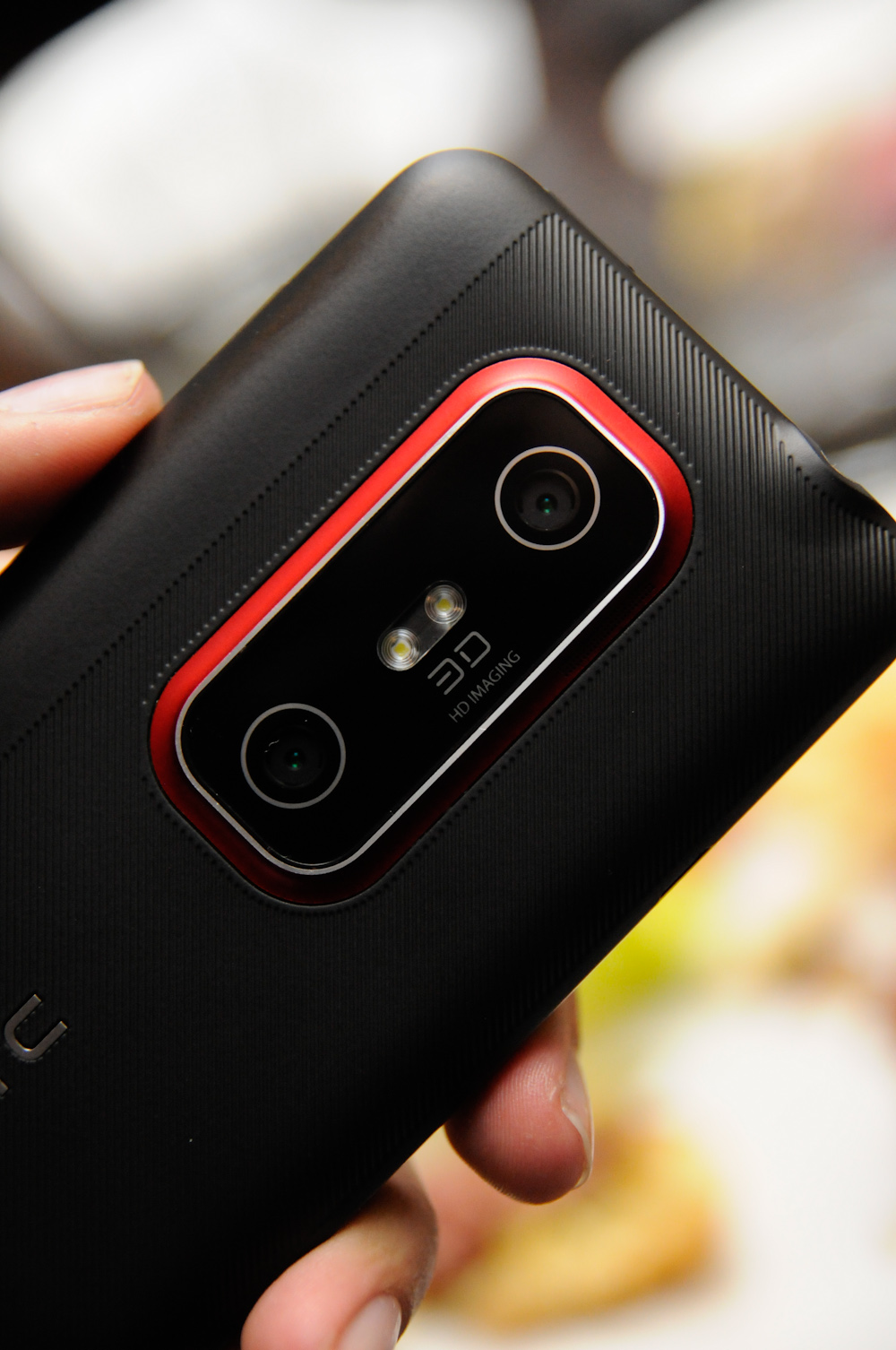
First up is the HTC EVO 3D, which is the as of yet unreleased 3D phone with WiMAX support destined for Sprint. WiMAX is provided by the same SQN1210 we've seen used in other HTC WiMAX phones. On the back are two immediately apparent 5 MP cameras for stereoscopic capture, and two LEDs for illumination. I didn't measure exactly how far apart the cameras are, but it appears comparable to the separation I saw with the LG Optimus 3D back at MWC.


Unlike the Sensation, the back of the EVO 3D is a plastic material that's lightly soft touch. It actually feels good in the hand thanks to the ridges that run diagonally across the lower four-thirds of the device. HTC's industrial design for the back of the EVO 3D also continues the blood-red theme that started back with the original EVO and Incredible. Underneath the battery cover however it's black however, no more bright red. The EVO 3D has a very large 6.57 Whr battery, one of the largest (if not the largest) I've seen in a smartphone to date.


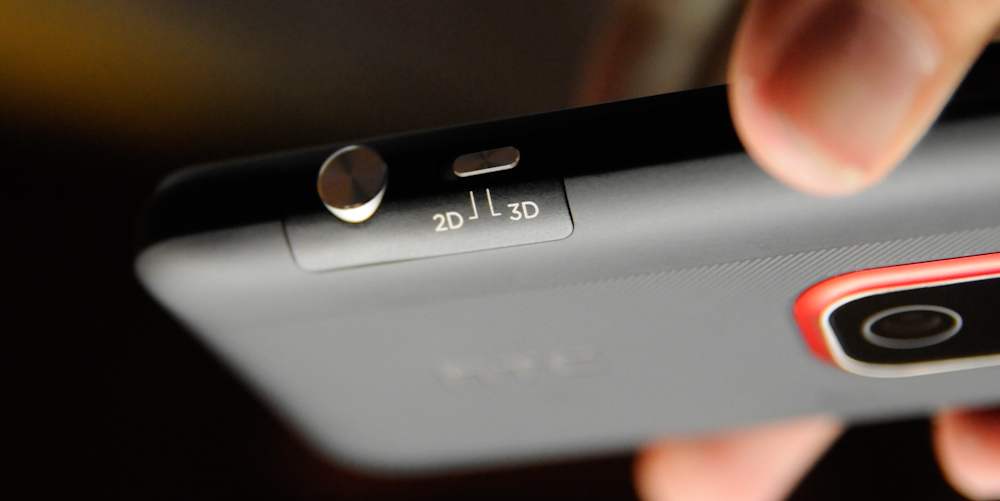
On the side of the EVO 3D is the 2D/3D toggle switch and shutter button, which is the largest and most pronounced I've seen so far. It's readily locatable and has great click. Like most other phones with camera buttons, the EVO 3D's is a two-step button.

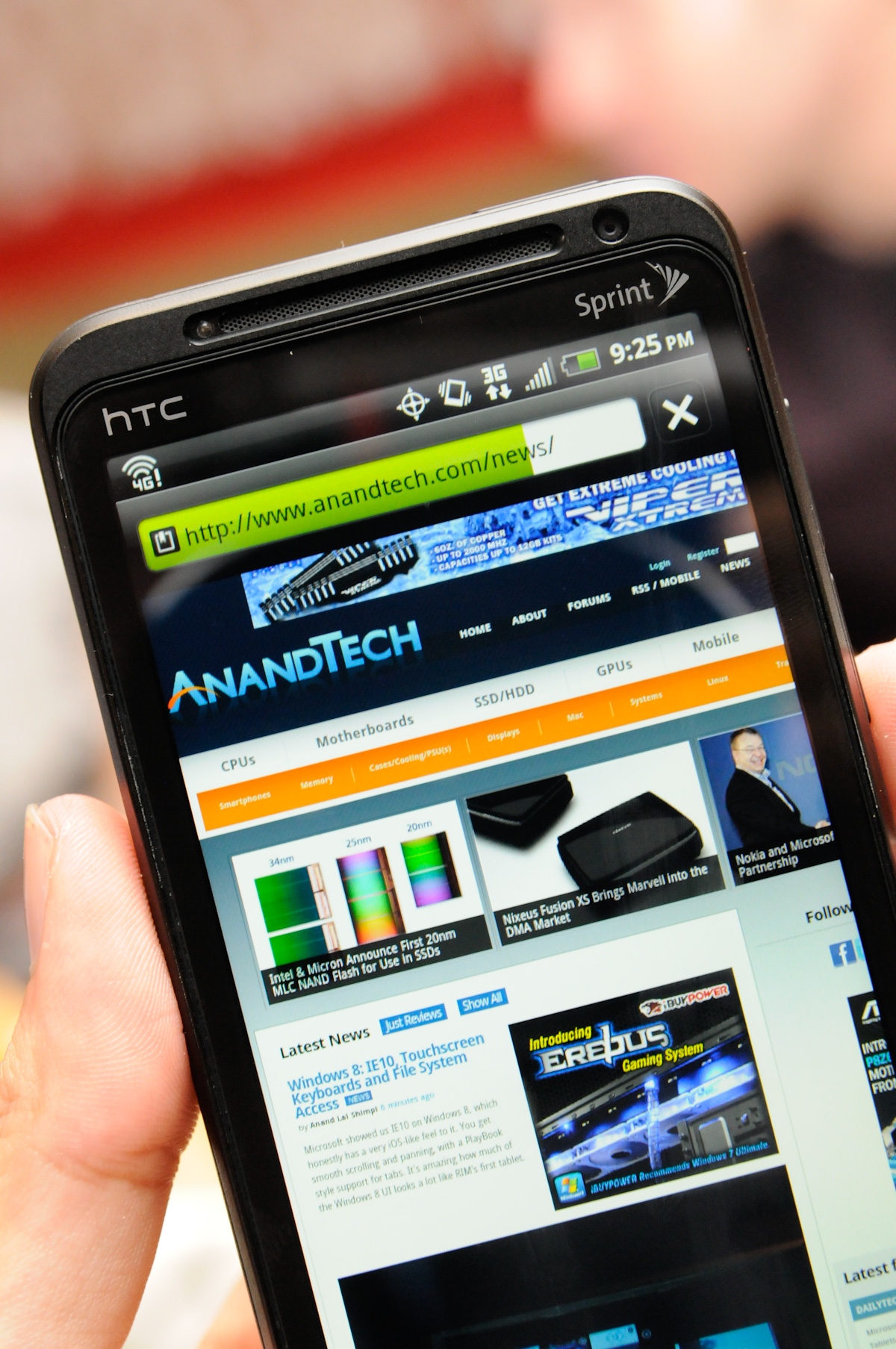
The front capacitive buttons are relatively standard fare and match what we've seen on the previous EVO brand smartphones. The EVO 3D and Sensation are both topped with a brilliant Super LCD (IPS) qHD 960x540 LCD display. While I didn't have any of my display analysis tools with me, at first glance viewing angles seemed very good, as did overall contrast. I'm still a fan of the good 'ol RGB stripe present in LCDs, and unlike other qHD LCD displays (like in the Atrix and Droid X2), the Sensation and EVO 3D both are free of Pentile. I think they look brilliant, and even though I'm still skeptical about qHD until it's officially added to the Android supported resolution table, I was pleased with the increased resolution available when browsing web pages.


The EVO 3D also includes an autostereoscopic display (glasses-free 3D) achieved through the use of a parallax barrier. There was Green Hornet preloaded in 3D, along with a few games that I didn't get a chance to launch, and the camera application. Inside the camera, it's essentially the same fare as what I saw with the LG Optimus 3D - you get a live 3D preview when you're shooting stills or video in 3D. You can shoot 2D video in 720P H.264, or 3D video which squeezes the left and right frame into one 1280x720 frame, effectively giving you 720P 3D video with half the horizontal resolution. You lose half the horizontal resolution using the parallax barrier anyhow, so what you see is truly what you get.

 
I found the EVO 3D's display a bit more challenging to align my head with and keep in an optimal location for viewing 3D than I remember the LG Optimus 3D being. In addition, I did notice a bit of ghosting. That said the underlying technology is the same as what virtually all the commercially available "glasses-free" 3D implementations are presently. 
 
HTC Sensation

The EVO's obvious sibling is the HTC Sensation, which trades the 3D display and dual camera setup for some truly awesome industrial design. I've been salivating over the Sensation for a while now after first seeing pictures and renders of it, and in person it doesn't disappoint one bit, this is the clear new flagship device for HTC.


The Sensation is a unibody design, meaning the entire case of the phone is one solid piece. The top and bottom (silver and black in the photo) regions are plastic, but serve as RF windows for the antennas that are printed on the inside. One continuous metal structure runs around the entire edge, and onto the front of the display as well, and necessitates a rather unique strategy to hold the phone together. Press on a tab at the bottom of the phone, and the whole back case slides upwards off of the phone. As a result of the unibody construction, the Sensation has an awesome in-hand feel that's notably solid.


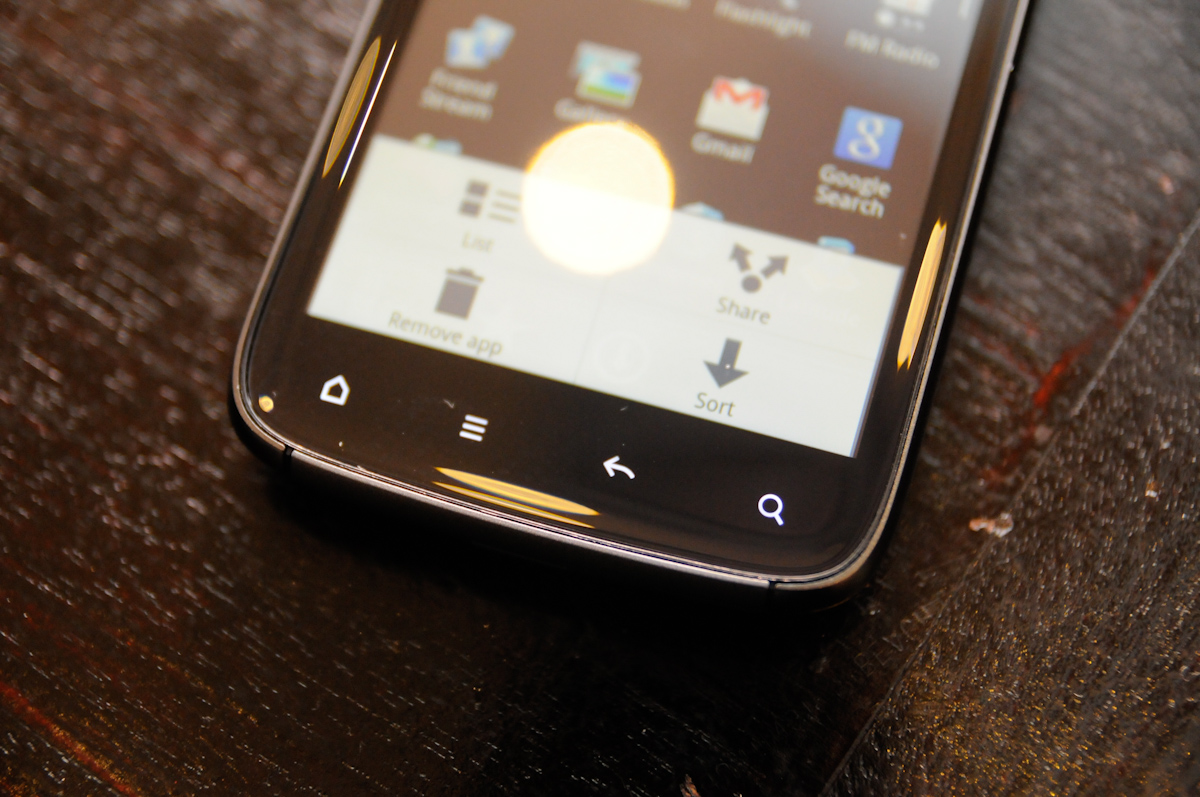
The front is again the same 4.3" Super LCD in the EVO 3D, just minus the parallax barrier that sits atop it. There's a slightly convex shape to the display, with a gentle curvature at the edges on all four sides. HTC has also slightly changed the Android button logos - they're more modern and minimalist now. Button order seems to have settled down, and remains the same as the Desire HD/Inspire 4G.


The Sensation also trades the dual 5 MP camera system for one 8 MP camera. Rumor has it that image quality on the Sensation is another step better than the 8 MP camera systems from the Inspire 4G/Desire HD due to both improvements in Qualcomm's ISP from MSM8x55 to MSM8x60, and some more software enhancements in the camera application and drivers by HTC. I didn't get to transfer any photos or videos off the device, but we'll find out soon enough. The Sensation's battery is 5.62 Whr which is notably smaller than the EVO 3D's. I was told by LG back at MWC that their own parallax barrier consumes on the order of single digit mA of current, and that in general at this size all do, so we'll see if the reason for the EVO 3D's larger battery is WiMAX soon enough.

The Sensation looks like a serious contender and will do some serious dual-core battle with the G2x when it arrives on T-Mobile stateside. 

Both the EVO 3D and Sensation also have the new HTC Sense, including glanceable lock screen, new animations, and a number of other enhancements. I have to say that it's nice to see HTC finally building information into the lock screens, and it looks good.


Last but not least are the HTC ChaCha and Salsa, the two Facebook phones. I didn't spend as much time with these two other than to quickly take some pictures and play with the ChaCha's keyboard, which makes it the more interesting of the two. The keys on the ChaCha are super clicky and have excellent communication. I'm intrigued by this form factor and wonder if HTC will try and make a more flagship Android device with keys on the front, sort of like their own attempt at BlackBerry form factor, similar to the Droid Pro. In my limited time with the ChaCha, I was impressed by the bend separating the keyboard region from the display, and the display dot pitch.

Saturday, May 28, 2011

Google Launches Mobile Wallet Payment Service (PR)

Google Inc. has officially announced the NFC based Mobile wallet payment service, in the United States. The Service comes with tie-ups and offers from retail and financial partners including Subway, Macy’s, Walgreens, Toys ‘R Us, First Data, Citibank and MasterCard.


At the Get go Nexus S 4G will be the only compatible phone, “over time, more phones will be supported” and Google even suggested that phones without built-in NFC could simply use an NFC sticker (the Google Wallet app itself will work on non-NFC phones as well). Only  Citi MasterCard or Google Prepaid Card with the service, the Google prepaid card can be purchased through any existing card.


PRESS RELEASE

 Google, Citi, MasterCard, First Data and Sprint Team up to Make Your Phone Your Wallet
 Google Wallet will enable consumers to tap, pay and save with their phones
NEW YORK–(BUSINESS WIRE)–At an event today, Google, Citi, MasterCard, First Data and Sprint announced and demonstrated Google Wallet, an app that will make your phone your wallet so you can tap, pay and save money and time while you shop. For businesses, Google Wallet is an opportunity to strengthen customer relationships by offering a faster, easier shopping experience with relevant deals, promotions and loyalty rewards.
“Macy’s is always looking for cutting-edge technology that will deliver value and engage our customers in personal ways. Google Wallet delivers this unique interaction across channels.”

“Today, we’ve joined with leaders in the industry to build the next generation of mobile commerce,” said Stephanie Tilenius, vice president, commerce and payments, Google. “With Citi, MasterCard, First Data and Sprint we’re building an open commerce ecosystem that for the first time will make it possible for you to pay with an NFC wallet and redeem consumer promotions all in one tap, while shopping offline.”
Google Wallet is currently in a field test and will be available to consumers this summer. At the event, Google, Citi, MasterCard, First Data and Sprint introduced Google Wallet and invited additional issuing banks, payment networks, mobile carriers, handset manufacturers, point of sale systems companies and merchants to join the initiative.
 Next Step in Mobile Payments 

At commercial launch, Google Wallet will support payments with two payment solutions: a PayPass eligible Citi MasterCard and a virtual Google Prepaid card. Most people who already have a PayPass eligible Citi MasterCard can simply add it to Google Wallet over the air, using First Data’s trusted service manager service. Or, they can fund the Google Prepaid card with any payment card.

Google Wallet uses near field communication (NFC) to make secure payments fast and convenient by simply tapping the phone on any PayPass-enabled terminal at checkout.

Google Wallet is engineered to enable secure payments and goes beyond what’s possible with traditional wallets and cards. It will require an app-specific PIN and in the first release, all payment card credentials will be encrypted and stored on a chip, called the secure element, that is separate from the Android device memory and is only accessible by authorized programs.

“Citi’s role as the lead bank in Google Wallet is the latest demonstration of how we are committed to becoming the world’s digital bank, providing to customers the tools they need to manage their everyday finances with convenience and value,” said Paul Galant, CEO, Citi Global Enterprise Payments. “Today’s announcement and our active collaboration with Google will be looked at as the inflection point for how mobile payments are evolving from concept to mass utilization.”

Accepted in Stores Nationwide

Google Wallet is built to work with the fast growing MasterCard PayPass network-a merchant point of sale service that enables consumers to tap to pay. As a result, Google Wallet will immediately be accepted at more than 124,000 PayPass-enabled merchants nationally and more than 311,000 globally.

“MasterCard has pioneered mobile payments with our PayPass technology and we’re proud that it is at the heart of Google Wallet,” said Ed McLaughlin, chief emerging payments officer, MasterCard. “We’re excited to partner with these industry leaders today and committed to continuing to play a leadership role in the development of mobile payment technologies.”

Google is also working with point of sale systems companies and top retail brands to create a new SingleTap shopping experience. Consumers will be able to pay for an item using a credit card or gift card, redeem promotions and earn loyalty points-all with a single tap of their Google Wallet. Google is working with VeriFone, Hypercom, Ingenico, VIVOTech and others to develop these next generation point of sale systems. Retailers participating in the new SingleTap experience include: American Eagle Outfitters, Bloomingdale’s, Champs Sports, The Container Store, Duane Reade, Einstein Bros. Bagels, Foot Locker, Guess, Jamba Juice, Macy’s, Noah’s Bagels, Peet’s Coffee & Tea, RadioShack, Subway, Toys”R”Us and Walgreens.

“Google Wallet allows us to harness the power of mobile technology to enhance our in-store shopping experience and helps bridge the gap between our online and in-store consumer interactions,” said Martine Reardon, executive vice-president of marketing and advertising, Macy’s. “Macy’s is always looking for cutting-edge technology that will deliver value and engage our customers in personal ways. Google Wallet delivers this unique interaction across channels.”

The first Google Wallet field tests are focused in New York and San Francisco, where many retailers, Coca-Cola vending machines and even taxis are PayPass-enabled, including major outlets such as CVS, Jack in the Box, Sports Authority and Sunoco. First Data, a global leader in electronic commerce and payment processing, is actively recruiting thousands of new merchants in these areas and will soon expand those efforts to deploy more contactless merchant terminals across the country.

“The payments industry has known for some time that it was not a question of if, but when true mobile commerce would become a reality. We believe today is the day that mobile meets payments,” said Ed Labry, president, North America, First Data. “We’re proud to play a central role in Google Wallet and to bring innovative technology such as Trusted Service Management and contactless acceptance to our clients.”

Saving Made Simple

Google has also been testing a variety of consumer deals that can range from a 20-percent discount on a new pair of boots discovered on a Google search advertisement; to a $5 off check-in offer received upon entering a store; to a “deal of the day” offering a $20 lunch for $10 at a local restaurant. Whenever you buy or save an offer, you will be able to automatically sync it to Google Wallet.

At most stores you will be able to use Google Wallet to show your offer at the register, where the cashier will either scan it or manually type it in. At participating Google SingleTap merchants, you will be able to pay and redeem an offer with one tap of your mobile device.

Because Google Wallet is a mobile app, it will eventually be able to do more than a regular wallet ever could-but without the bulk. Google Wallet will start with offers, loyalty and gift cards but some day items like receipts, boarding passes and tickets will all be seamlessly synced to your Google Wallet.

Open Commerce Ecosystem = Consumer Choice and Innovation

Google Wallet will work best if it’s an open commerce ecosystem so you will be able to carry all the credit cards, offers, loyalty and gift cards you choose-and eventually much more. To this end, Google Wallet will make it possible to integrate numerous types of partners, and Google, Citi, MasterCard, First Data and Sprint invite the banking community, mobile carriers, handset manufacturers, merchants and others to work with Google Wallet.

“We are delighted to be the first carrier to sign on as a partner with Google to deliver Google Wallet,” said Fared Adib, senior vice president of product development, Sprint. “As a leading innovator and proponent of “open,” we are proud that Nexus S 4G is the first smartphone with Google Wallet and we look forward to deploying Google Wallet on many of our upcoming Android phones.”

The first release of Google Wallet is expected to be released on the Nexus S 4G on the Sprint network. Additional devices with NFC capabilities will follow. Sign up to be notified about the release at google.com/wallet.

About Google Inc.

Google (NASDAQ: GOOG) is a global technology leader focused on improving the ways people connect with information. Google’s innovations in web search and advertising have made its website a top internet property and its brand one of the most recognized in the world. For more information, visit www.google.com/about.html.

About Citi

Citi, the leading global financial services company, has approximately 200 million customer accounts and does business in more than 160 countries and jurisdictions. Through Citicorp and Citi Holdings, Citi provides consumers, corporations, governments and institutions with a broad range of financial products and services, including consumer banking and credit, corporate and investment banking, securities brokerage, transaction services and wealth management. Additional information may be found at www.citigroup.com.

About MasterCard

As a leading global payments company, MasterCard (NYSE: MA) serves as a franchisor, processor and advisor to the payments industry, and makes commerce happen by providing a critical economic link among financial institutions, governments, businesses, merchants and cardholders worldwide in more than 210 countries and territories. For more information, please visit us at www.mastercard.com. Follow us on Twitter: @mastercardnews.

About First Data

Around the world, every second of every day, First Data makes payment transactions secure, fast and easy for merchants, financial institutions and their customers. First Data leverages its vast product portfolio and expertise to drive customer revenue and profitability. Whether the choice of payment is by debit or credit card, gift card, check or mobile phone, online or at the checkout counter, First Data takes every opportunity to go beyond the transaction.

About Sprint

Sprint Nextel offers a comprehensive range of wireless and wireline communications services bringing the freedom of mobility to consumers, businesses and government users. Sprint Nextel served more than 51 million customers at the end of 1Q 2011 and is widely recognized for developing, engineering and deploying innovative technologies, including the first wireless 4G service from a national carrier in the United States; offering industry-leading mobile data services, leading prepaid brands including Virgin Mobile USA, Boost Mobile and Assurance Wireless; instant national and international push-to-talk capabilities; and a global Tier 1 Internet backbone. Newsweek ranked Sprint No. 6 in its 2010 Green Rankings, listing it as one of the nation’s greenest companies, the highest of any telecommunications company. You can learn more and visit Sprint at www.sprint.com or www.facebook.com/sprint and www.twitter.com/sprint.


Saturday, April 23, 2011

How The iPad Changes PC Design

Consumers prefer light to heavy. Thin to thick. And that's why more laptops will, slowly but surely, begin to imitate the internals of the iPad.

Reason #1--Flash memory: Apple's iPad (not to mention the iPhone) is a major force driving flash memory development and production. Apple obviously has a thing for flash chips (so much so that it has periodically made headlines about its ravenous appetite for this silicon delicacy).

Laying down a solid-state drive (aka flash drive) on the main system board can alone make for a much smaller, lighter design (see photos). Want more proof? Just look at this teardown of the 2011 MacBook Pro to see the relatively large size of a standard magnetic hard disk drive.

And witness what's been occurring over the last couple of weeks. Flash memory and solid-state drive manufacturers like Micron-Intel, Toshiba, and SanDisk have all been tripping over themselves to announce denser flash memory. Here's what Micron Technology said: "Intel and Micron...expect to unveil samples of a 16GB device, creating up to 128GBs of capacity in a single solid-state storage solution that is smaller than a U.S. postage stamp."

Translation: next year denser, less expensive flash drives and solid-state drives. And, I predict, more laptops like the Air and Samsung's Series 9. Though higher-performance solid-state drives will likely never rival the gigabyte-per-dollar economics of the magnetic HDD, they will finally come down enough in price that 256GB (or larger) solid-state storage won't be a barrier to mainstream market designs in the last half of 2012.

The iPad 2's main circuit board: More ultra-portable laptops will mimic the iPad's internals.

The iPad 2's main circuit board: More ultra-portable laptops will mimic the iPad's internals.
(Credit: iFixit)
 
The 2010 MacBook Air's main board, like the iPad's, packs a lot into a small space. And, come to think of it, the Air preceded the iPad (and the iPhone arrived before both).

The 2010 MacBook Air's main board, like the iPad's, packs a lot into a small space. And, come to think of it, the Air preceded the iPad (and the iPhone arrived before both).
(Credit: iFixit)

Reason #2--Processors: small, power-efficient ARM chips will gain in performance as manufacturing process technology advances and land in more feature-rich personal computing devices. Designs like Apple's A5 (and future A6) and Nvidia's Tegra are already taking on some of the characteristics of PC processors (two cores with symmetric multiprocessing). At the other end of the spectrum, Intel is racing to get its processors into tablets and even smartphones. And, more generally, Intel's PC-class processors are emulating chips like the A5 by packing more functionality onto the main processor, resulting in more power efficient silicon (the hallmark of the A5). Proof of the latter trend will come this summer when Apple puts Intel's most power-efficient Sandy Bridge chips into the MacBook Air.

Reason #3--Aesthetics: I think it's safe to say that consumers seem to like the iPad. Form and function combine to make it irresistible for many business users and consumers. By extension, this applies to the MacBook Air and similar laptop designs that emerge.

Saturday, January 15, 2011

CES Xperia arc Nexus S Motorola Atrix & LG Revolution 2011


This year you weren’t anyone if you didn’t announce a new smart phone, the majority of which are now powered (or based upon) the Android operating system. Being “Latest Gadgets” rather than “Latest Phones” meant that we only focused on the phones that caught our eye, rather than trying to provide a complete list of all the phones launched at this year’s show. So, without further ado, here are the ones that made us sit up and take notice (and not always for the right reason!).


Xperia ‘arc’ by Sony Ericsson

First up is the ‘visually brilliant’ Xperia arc. This is the firm’s first phone to feature a mobile version of the Bravia engine and comes with the latest version of Android. The phone comes complete with an HDMI output to view your videos and photos on your TV as well as ‘Sony Exmor R’ for mobile which helps with low-light photography. Being in a brightly lit exhibition hall didn’t give us much opportunity to test this particular feature, but we did have a quick play with the rest of the phone.  Unfortunately our first impression wasn’t overly positive, we found the interface to be rather slow and the design of the phone (as seen in our candid snapshots above – click to enlarge) wasn’t anything to write home about.

Nexus S’ by Samsung/Google


Next up is the latest phone from Google, featuring Android 2.3, full integration (as you’d expect) with Google Mobiles Services and a Super AMOLED display. The phone’s design was perfectly acceptable and comfortable to hold. The feedback vibration when using the screen was reassuring rather than annoying. In terms of usability and speed – we initially found the phone to be extremely laggy and attempting to view a sample video resulted in a black screen.

However, all of this was rectified by a Samsung employee who performed the classic ‘turn it off and on again’ routine. Having done this, we found the Nexus to be much quicker and more responsive than the ‘arc’. The Nexus S will also come with support for Flash 10.1 and HTML 5 to enable ‘full use’ of web sites.

Motorola ‘Atrix’

Motorola, ever so modestly, introduced their new Atrix phone as the “World’s most powerful smartphone”. The Atrix comes with a dual core processor which promises faster, smoother graphics and web browsing. It also comes with the World’s first qHD display and a web browser that supports Flash – something which, unsurprisingly, all manufacturers are shouting from the roof tops in order to try and get one over on Steve Jobs and Co.

The unusual and somewhat intriguing (in our opinion at least!) part of the Atrix offering is what the firm calls a ‘revolutionary webtop application’. This is basically a latop-cum-docking station for your Atrix which gives you a bigger screen and full-size QWERTY keyboard. The idea is that you have one of these “I can’t believe it’s not a laptop” devices at home and work and then carry all your files on your phone. Unfortunately the design of the laptop appeared to be very basic and it had a distinctly plasticky feel to it. Motorola aren’t known for their laptops (as far as we know!) and we’re not sure that venturing in to this field is the way to go. However, stranger things have happened – so we’re prepared to eat our hat if this turns out to be the future of mobile computing!

Revolution by LG

Like most firms, LG announced a whole range of new smart phones at this year’s CES, but again we’ve just focused on the one that caught our eye. In this case it was the ‘Revolution’ which will initially be available on the Verizon network in the US. However we imagine that we’ll see it at some point in the future in the UK but perhaps under a different guise or product name.

The main headline offering from the Revolution is its support for full HD streaming, playback and recording. This means you can wirelessly stream content from your phone to any compatible TV – and we were told this doesn’t just include LG sets. In addition to HD support, the Revolution comes with all the features you’ve come to expect, such as dual cameras for video calling, a 5M AF camera with LED flash, WIFI, Bluetooth, etc. A nice additional touch is that the Revolution comes with a wireless charger which we didn’t see in action but imagine will become more common place in the year to come.

Sunday, January 2, 2011

Apple iPad And iPhone Most Popular Searches For 2010

Leena Rao 5 hours ago

With eBay handling more than 2 billion U.S. product searches a quarter, the marketplace can show what items are most desirable in a given time. We recently wrote about what was trending on eBay during the holiday shopping period, and today the market place is releasing its most popular product searches in 2010.

Apple dominated the list, with the iPad and iPhone 4 taking the top two spots, respectively. These gadgets were followed by Victoria’s Secret, Nintendo Wii Games, Nintendo DS, Playstation 3, Nikon d90, diamond ring, sunglasses and laptops.

While there were some outliers in the list (i.e. Victoria’s Secret), it seems that searches on the marketplace were dominated by electronics and gadgets. The iPhone 4 actually topped eBay’s “top shopped” list, which revealed top products that consumers actually bought (as opposed to searched for) on eBay. In terms of top shopped, the iPad followed the iPhone 4 in fifth place.

Collectively, the iPhone 4 (which sold 1.6 million related products) and the iPad accounted for over 2.2 million related products sold (this includes cases, etc.).

Interestingly, neither the iPad or iPhone 4 made Amazon’s top products list this year (both are not sold on Amazon); the Kindle took the stop spot on Amazon’s list.

Saturday, January 1, 2011

iPhone iPod Touch Available Skype Video Calling


Apple iPhone users have been waiting a long time for this, and just in time to call up your best friend on New Year's Eve and communicate via video instead of just voice, Skype has delivered video calling to the iPhone. Before now, Skype was only useful for VoIP calling and messaging. Skype video calling is a feature, but it was reserved for the desktop client and select televisions. Now, video calling is where it should be: right beside FaceTime. What's crazy is that somehow Skype has been able to launch this feature over both Wi-Fi and 3G. Other similar apps have usually launched with support for Wi-Fi only, and even Apple's own FaceTime is restricted to use over Wi-Fi.


Skype has stated that video calling made up 40% of all Skype-to-Skype minutes during the first 6 months of 2010, so it's pretty clear that there's a significant demand for this on the mobile side. Early reports have found that 3G video chatting is spotty, while Wi-Fi video chatting seems pretty solid. The app is free, so why not give it a try and see for yourself?

Skype Brings Video Calling to iPhones

Share the Moments that Matter Most over 3G and WiFi

30 DECEMBER, 2010 – Luxembourg – Skype today announced the new version of its iPhone application that brings video calling to millions of mobile users around the globe over both 3G and WiFi networks. Available to download from the Apple App Store today, the new Skype for iPhone App allows iPhone , iPad and iPod touch owners to make and/or receive free* Skype video calls for the first time. Users can now see their family, friends and colleagues around the world while talking to them. With approximately 25 million concurrent users logged into Skype at any given time**, the new Skype for iPhone makes it easier than ever to share moments wherever you are.

Video calling significantly enhances the user experience of Skype for iPhone, which is one of the top five free iPhone apps in 2010 according to Apple. Now, users can make and receive free Skype-to-Skype calls, call mobiles and landlines around the world at very low rates, and now share more moments together with video on Skype for iPhone.

"With video calling representing approximately 40% of all Skype-to-Skype minutes for the first six months of 2010, our users have been eager to get Skype video calling on their mobile phones," said Neil Stevens, general manager of Skype's consumer business. "By bringing video to mainstream users at their home or work via their desktops, on the go with their mobiles, or into their living room via their TV, Skype has made it possible for millions of people to share video moments wherever they are."

A video call evolves communication beyond transactional experiences to a shared experience where people can share any occasion with others wherever they are. Whether this is a military father watching the birth of his child while deployed abroad, loved ones communicating via sign language or work colleagues collaborating around the globe – the opportunities are endless.

Users can place Skype video calls with their iPhone over both a 3G data connection* or WiFi. The new Skype for iPhone app is compatible with the iPhone 4, iPhone 3GS, and iPod touch 4th generation with i0S 4.0 or above. Video receiving capabilities are available on the iPod touch 3rd generation and iPad. Calls can be made between devices using the new Skype for iPhone app and desktops including Skype for Windows 4.2 and above, Skype for Mac 2.8 and above, Skype for Linux and ASUS Videophone.

The Skype for iPhone application is available for free download from the App Store or at 

www.skype.com/go/iphone

Related Posts Plugin for WordPress, Blogger...
Powered by Blogger.